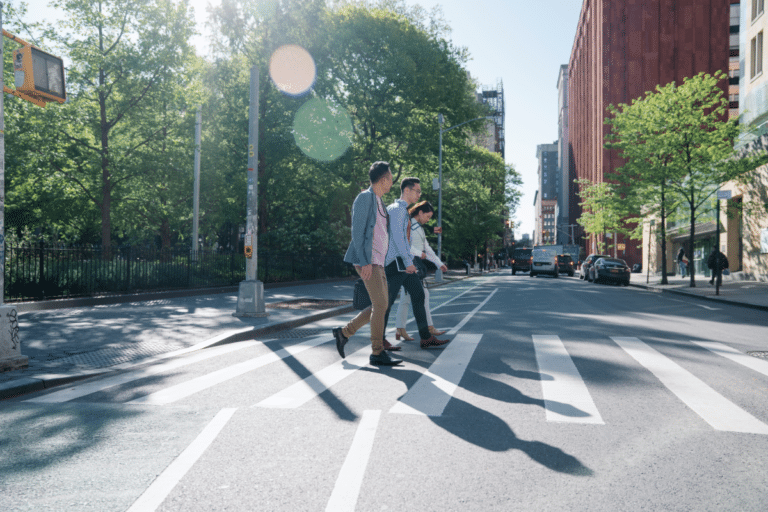
Crosswalks come in two forms: the visible ones that every driver recognizes, and the quiet ones that exist by law even without paint or signs. The second type, unmarked crosswalks, often go unnoticed, yet they carry the same legal weight as marked crosswalks for pedestrian safety and right-of-way.
An unmarked crosswalk is a legal passage built into most intersections where sidewalks line up across the street. Even when there’s no paint on the pavement, pedestrians still have the right to cross, and drivers must yield. These spaces are part of how streets are designed to function safely for everyone who uses them.
At Feller & Wendt, LLC™, pedestrian safety is part of a broader mission: protecting the people who share Utah’s roads. The firm represents those injured in traffic collisions and works to clarify laws that affect everyday movement through cities and neighborhoods.
Table of Contents
- Where Unmarked Crosswalks Are Located
- Do You Need To Yield to Pedestrians in Unmarked Crosswalks?
- Marked vs. Unmarked Crosswalks
- Common Accidents at Unmarked Crosswalks
- Driver Responsibilities at Unmarked Crosswalks
- How a Pedestrian Injury Attorney Can Help
- Reach Out to Feller & Wendt, LLC™ for Your Crosswalk Accident Case
Where Unmarked Crosswalks Are Located
Unmarked crosswalks often sit at intersections where sidewalks meet on both sides. Every standard intersection in Utah includes one on each corner unless signs prohibit pedestrian access. They may not exist where there’s no sidewalk, such as on highways or rural stretches built for vehicle travel only.
Urban planners designed these spaces with the expectation that people would naturally walk from one corner to another. A person crossing at an intersection without painted lines is still in a crosswalk if they remain within the lines extending from one sidewalk to the other. In places with four-way corners, that means four unmarked crosswalks.
Different jurisdictions define their boundaries in specific ways, but the underlying purpose remains consistent: providing pedestrians a recognized route to cross safely, even when the paint fades or was never applied.
Do You Need To Yield to Pedestrians in Unmarked Crosswalks?
You do. Drivers must yield to pedestrians lawfully crossing within any intersection, whether it’s marked or not. Utah traffic law requires that when someone steps from one sidewalk to another within an intersection, vehicles must stop and allow them to cross.
Pedestrians share that duty of care. They must look both ways, step carefully, and enter only when vehicles can reasonably stop. That balance keeps traffic moving while protecting pedestrians.
A pedestrian stepping from one sidewalk to another within an intersection is protected. The driver’s job is to stop and let them pass. But that protection works both ways. Pedestrians also need to cross responsibly, making sure vehicles have time to slow down.
Picture a driver turning right through a quiet residential street while someone steps off the opposite curb. Even without paint or a sign, it’s still a crosswalk. The driver must yield. If that person darts into traffic, responsibility may be shared.
Safety depends on awareness. Utah’s rules make that clear, and Utah’s unmarked crosswalk laws explain how those protections work in practice.
Marked vs. Unmarked Crosswalks
The visual difference between marked and unmarked crosswalks is easy to spot. One relies on signs and symbols to alert drivers; the other depends on law and habit. In practice, both offer the same legal protection. A pedestrian crossing where sidewalks connect through an intersection retains the right-of-way regardless of visible markings.
Paint improves visibility, especially at night or during bad weather, but it doesn’t create the right-of-way. It just reminds everyone of it. A driver who fails to yield at an unmarked crossing is as responsible as one who ignores painted stripes.
Accidents happen in both places. Data from the Federal Highway Administration shows that lighting, traffic flow, and driver attention play a greater role in pedestrian safety than markings themselves.
| Feature | Marked Crosswalks | Unmarked Crosswalks |
|---|---|---|
| Visibility | Clearly painted lines or signs | No visible markings |
| Location | Often near schools, intersections, or busy streets | Typically at intersections without painted lines |
| Right-of-Way | Pedestrians have legal right-of-way | Pedestrians have the same right-of-way |
| Safety | More visible to drivers | Less visible, requires extra caution |
| Common Risks | Distracted driving, ignoring signs | Driver inattention, lack of awareness |
Common Accidents at Unmarked Crosswalks
Many pedestrian accidents occur at unmarked intersections. Common types include:
- Failure to yield: Drivers turning or passing through intersections sometimes fail to yield to pedestrians entering the crossing.
- Turning collisions: Vehicles turning left or right at traffic lights often cross invisible crosswalks.
- Speed-related incidents: High speed limits shorten reaction time, especially when crosswalks lack clear indicators.
- Visibility issues: Poor lighting, parked vehicles, or adverse weather can hide pedestrians from view until it’s too late.
Even when a crosswalk isn’t marked, the law still protects those who walk it. Pedestrians injured by negligent drivers can seek full compensation for medical bills, lost income, and other losses. The key is evidence: photos, witnesses, police reports, and medical records.
After an incident, documenting the scene and contacting law enforcement builds the foundation for any potential claim. Photos of the intersection, witness statements, and medical evaluations all help establish fault.
If you ever experience a pedestrian collision, early communication with an experienced injury lawyer helps preserve evidence and protect your rights. The team at Feller & Wendt, LLC™ has secured results for clients facing similar situations through focused investigation and advocacy.
Driver Responsibilities at Unmarked Crosswalks
Every driver approaching an intersection carries a duty to look for pedestrians, even when no crosswalk is visible. The absence of paint never shirks responsibility. Safe driving at unmarked crosswalks depends on anticipation and control.
Key responsibilities include:
- Yielding to pedestrians already in the intersection or entering it from the curb.
- Reducing speed when approaching intersections, school zones, or residential areas.
- Scanning both directions for movement near sidewalks, especially where visibility dips at night or during bad weather.
- Avoiding distractions such as mobile devices that delay reaction time.
- Preparing for sudden stops by maintaining a distance from the car ahead.
Ignoring these duties brings serious consequences. Utah law allows citations for failure to yield and holds drivers responsible for injuries that result from unsafe behavior. Civil liability can include the cost of medical treatment, lost income, and lasting pain. A single careless moment can change someone’s life, and the weight of that knowledge stays with the person who caused it.
How a Pedestrian Injury Attorney Can Help
A pedestrian accident often unfolds in seconds but can take months or years to resolve. An attorney helps by guiding clients through confusion to action. Legal support includes:
- Investigating fault: Reviewing reports, footage, and witness statements to determine what happened.
- Collecting evidence: Preserving photos, traffic data, and medical records that prove liability.
- Handling insurance negotiations: Communicating directly with adjusters to prevent low settlement offers.
- Determining fair compensation: Calculating both immediate and long-term losses related to recovery.
- Applying legal expertise: Interpreting Utah’s traffic and personal injury laws to strengthen a client’s claim.
Working with an attorney also provides reassurance. The legal process becomes more manageable when someone experienced guides each step. Feller & Wendt, LLC™ attorneys bring both empathy and precision to every case, helping clients rebuild stability after serious accidents.
Our firm has a proven history of advocacy, with case results showcasing outcomes achieved on behalf of Utah injury victims.
Reach Out to Feller & Wendt, LLC™ for Your Crosswalk Accident Case
The days after a pedestrian crash are a blur. You’re tired, hurt, and trying to make sense of what happened. That’s when you need help from someone who already knows the road ahead.
At Feller & Wendt, LLC™, we take that pressure off your shoulders. Our attorneys have spent years handling these cases, from quiet neighborhood intersections to busy downtown crosswalks. We understand how one careless driver can upend an entire life.
When you come to us, we handle the details so you can focus on getting better. Whether your accident happened in a marked crosswalk or at an unmarked corner, the mission stays the same: protect your rights and make sure you’re treated fairly.
Call 801-499-5060 or reach out through the firm’s free consultation form. We’ll listen, we’ll explain your options, and we’ll start building a plan that fits what you need right now.
* This information provided by Feller & Wendt, LLC™ is for informational purposes only and should be in no way construed as legal advice.