Crosswalks are the most common point where people and traffic meet. The rules governing those crossings determine who must stop, who may proceed, and who is responsible when something goes wrong. Utah law defines these responsibilities in detail, spelling out when pedestrians have the right of way, when drivers must yield, and what happens after an accident.
Knowing those laws helps everyone on the road stay safer. It also determines how fault is assigned after a collision. At Feller & Wendt, LLC™, we represent Utah pedestrians and drivers involved in crosswalk incidents. Many cases begin with a single question: what does state law actually require?
Understanding Utah Crosswalk Laws
Utah Code § 41-6a-1002 defines a crosswalk as any portion of a roadway marked for pedestrian crossing or the part of an intersection that connects sidewalks on opposite sides. Most Utah intersections include at least one legal crosswalk, even if no lines are painted on the pavement.
The statute identifies two types of crossings: marked and unmarked. Marked crosswalks display visible white stripes or painted lines to signal drivers to stop when someone enters the roadway. Unmarked crosswalks automatically exist wherever sidewalks connect across a street, and carry the same legal protection as painted ones.
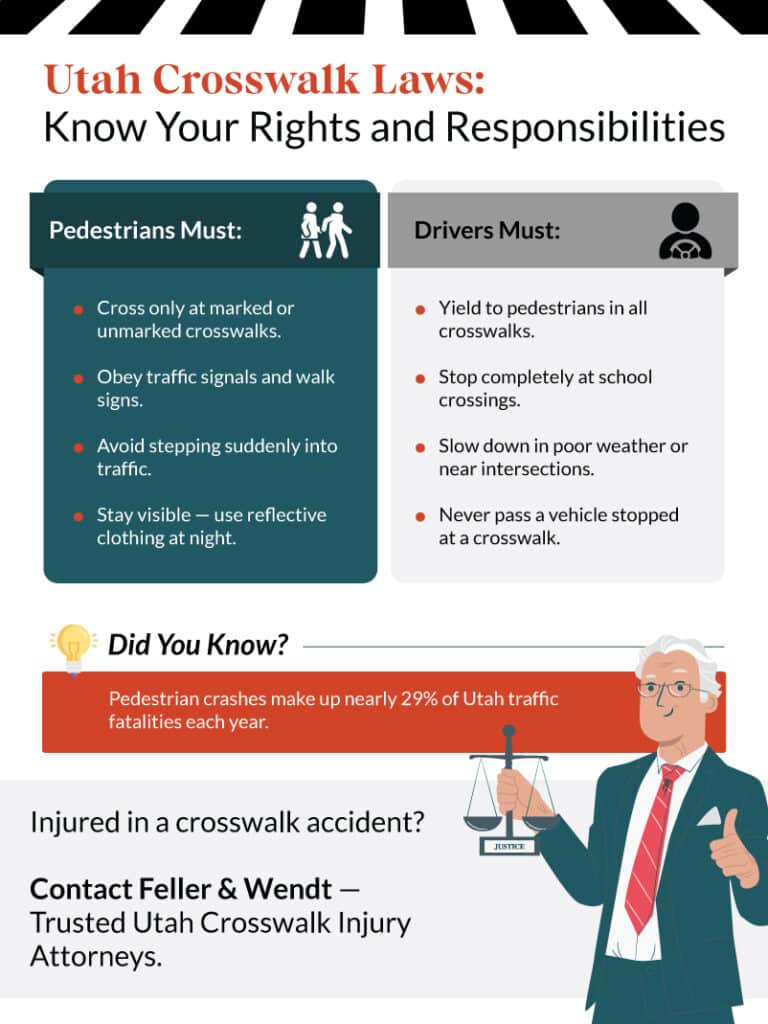
Under Utah Code § 41-6a-1006, drivers must yield to pedestrians who are crossing within either type of crosswalk on their side of the road. A vehicle must stop before the crosswalk line and remain stopped until the person reaches the opposite curb. Drivers are also prohibited from passing another vehicle that has stopped at a crosswalk.
Ignoring these rules can lead to fines and license points. More serious violations may bring civil liability when injuries occur. Pedestrian crashes remain a significant cause of traffic deaths in Utah, often happening where drivers fail to anticipate someone stepping out into the street.
Pedestrian Responsibilities in Utah
Pedestrian rights in Utah come with clear duties. People on foot must use designated crossings when they are available and must obey traffic control signals. When the “Don’t Walk” light is active, entering the roadway violates state pedestrian laws.
Pedestrians must also remain on the right half of the crosswalk whenever practical. Entering the street between intersections or walking into traffic from behind parked cars is not only dangerous, but also violates the Utah Code. A person walking outside a crosswalk must yield to all vehicles already on the roadway.
If a pedestrian moves into the path of a vehicle that cannot stop safely, the pedestrian may be found at fault. Utah’s comparative negligence system allocates responsibility based on each party’s actions. That shared-fault rule affects compensation after a crash.
Practical safety habits reduce that risk. Waiting for the signal, making eye contact with drivers, and wearing reflective gear at night protect pedestrians both physically and legally.
Utah Pedestrian Crosswalk Laws
When a pedestrian crosses within a marked or unmarked crosswalk, vehicles must stop until that person clears the lane. Drivers in every lane moving in the same direction must yield once a pedestrian steps into the crosswalk.
Utah law also covers intersections without lights. Even where no signals are present, a driver must yield to anyone already crossing or approaching the half of the roadway the vehicle occupies. This expectation applies to city streets, suburban intersections, and residential roads alike.
Pedestrians who step off the curb between parked cars or cross the street at an angle take on added risk. In those situations, Utah’s comparative negligence law divides responsibility according to each person’s actions. A moment of distraction, such as checking a phone or crossing mid-block, can influence how compensation is calculated when a case settles or goes to court.
Utah’s unmarked crosswalk laws help explain how these intersections function and outline the same rights and responsibilities that apply even when no paint marks the crossing.
Driver Responsibilities in Utah
Drivers hold the greater duty to prevent harm. Utah law requires vehicles to stop for pedestrians at both marked and unmarked crosswalks. Once a person steps into the roadway, drivers must stop completely and wait until the crossing is clear.
The “due care” provision strengthens that obligation. Drivers must operate with constant attention to pedestrians and avoid collisions whenever possible. That includes slowing when approaching intersections, watching both sides of the street, and remaining alert in poor weather or low-light conditions.
Turning movements create additional hazards. A driver turning right on red must check for oncoming traffic before proceeding. Left-turning drivers must yield to anyone crossing the lane they intend to enter.
In school zones, a failure to yield brings fines and consequences such as license suspension or revocation. Vehicles cause the greatest harm; therefore, drivers bear the greatest responsibility to prevent injury.
Penalties and Liability for Crosswalk Violations
Violating Utah’s crosswalk statutes results in both traffic penalties and potential civil litigation. A driver who fails to yield may receive a citation, incur fines, and add points to their record. Multiple violations can prompt license review and increased insurance premiums.
Under Utah Code § 41-6a-1106, a driver who violates pedestrian right-of-way laws may be found negligent in court. When a pedestrian suffers injury, that violation can establish fault for purposes of civil recovery.
Recoverable damages include treatment costs, lost income, and the physical and emotional toll of an injury. A proven crosswalk violation typically signals negligence in the eyes of insurers and courts. Under Utah’s comparative negligence standard, a pedestrian may obtain compensation provided their level of fault does not exceed 50 percent.
For practical guidance on how Utah communities enforce crosswalk rules, local safety standards illustrate the expectations placed on both drivers and pedestrians to act with care and awareness.
How a Crosswalk Injury Attorney Can Help
After a crosswalk accident, most people feel overwhelmed. Medical treatment, insurance calls, and uncertainty take over daily life. A pedestrian injury attorney helps by managing the details and restoring a sense of order.
The attorneys at Feller & Wendt, LLC™ begin with an investigation. We collect police reports, witness statements, traffic footage, and measurements from the scene—evidence that forms the foundation of a strong case. Our team then handles insurance communication to protect clients from low offers or misinterpretation of facts.
If negotiations stall, the firm is prepared for litigation. The courtroom experience of Feller & Wendt, LLC™ gives clients a clear advantage during trial, and our firm’s case results show consistent success for pedestrians and families facing the consequences of preventable accidents.
Feller & Wendt, LLC™: Crosswalk Injury Attorneys
Everyone who uses a crosswalk relies on one another’s attention. When that attention lapses, the results can be devastating. Legal representation helps injured pedestrians regain control of their recovery and understand the next steps.
Feller & Wendt, LLC™ provides guidance rooted in experience and accountability. Our attorneys handle pedestrian-injury cases across Utah, focusing on results that restore financial and personal stability.
To start, contact the team through the free consultation form or call 801-499-5060. The consultation is confidential and designed to help you understand your rights, your options, and how to move forward.